

Peptide COAs: Why “Third-Party Tested” Proves Virtually Nothing
- biobondlabs
- Jun 26
- 9 min read
Peptide COAs: Why “Third-Party Tested” Proves Virtually Nothing

Few phrases carry more weight in the online peptide market than “third-party tested.”
Sellers place it on product pages, social media graphics, and vial images. Buyers repeat it in Facebook groups as if those three words settle every question about quality. A certificate of analysis is posted, the purity number looks impressive, and the product is declared clean and reliable.
That conclusion is usually based on far less evidence than consumers realize.
A legitimate certificate of analysis can provide useful information about a sample submitted to a laboratory. Without authenticated batch traceability, however, it does not prove that the vial being sold came from the tested material.
In many cases, “third-party tested” is little more than a marketing phrase.
What Peptide COAs Actually Prove

A certificate of analysis, commonly called a COA, summarizes the results of laboratory testing performed on a specific sample.
On its own, the document proves only that a laboratory reported certain findings for the sample it received.
It does not automatically prove:
Who manufactured the sample
Who selected it for testing
Whether it represented the full production batch
Whether the seller’s current inventory came from that batch
Whether the customer’s vial matches the batch on the report
Whether the report has been altered
Whether the testing evaluated every important quality attribute
Those are not minor technical details. They determine whether the COA has any meaningful connection to the product being sold.
A laboratory can perform excellent work and issue a completely authentic report for a sample that has no provable relationship to the vial in the customer’s hand.
Peptide COAs Require Batch Traceability

Imagine that a reseller purchases 1,000 peptide vials from an overseas supplier and submits one vial to a laboratory.
A favorable result describes the vial that was tested. It may provide evidence about the larger batch, but only if the seller can demonstrate that all 1,000 vials came from the same production batch and that the tested vial was representative of it.
For the COA to mean something to the buyer, several links must remain intact:
The manufacturer assigns a production batch or lot number.
The tested sample comes from that batch.
The laboratory report identifies that batch.
The finished vials retain the same traceable identifier.
The vial received by the customer carries a matching number.
If the product has no batch or lot number, the chain ends. The customer has no reliable way to connect the physical vial to the published report.
This is especially important when sellers display COAs tested many months or even years earlier. An old report may still be relevant to the original batch, but it says nothing about newer inventory unless the seller can prove that the product currently being shipped came from that same tested lot.
Without matching identifiers, the consumer is simply being asked to trust the seller’s word.
A 99% Purity Result Does Not Prove Complete Quality

Many peptide COAs prominently display a purity result from high-performance liquid chromatography, commonly called HPLC.
That result can be useful, but it is often misunderstood.
A reported purity of 99 percent does not necessarily prove:
The exact identity of the compound
The amount of peptide in the vial
The accuracy of the labeled quantity
Sterility
Acceptable bacterial endotoxin levels
The absence of residual solvents
Stability during shipping and storage
Consistent filling across the batch
A vial could contain a highly pure peptide but less material than the label claims. It could contain the expected amount and still fail sterility or endotoxin testing.
Identity, purity, quantity, sterility, endotoxin levels, residual solvents, and stability answer different questions. No single test result provides a complete quality profile.
The phrase “99% pure” sounds comprehensive. It usually is not.
Authentic Reports Can Still Be Irrelevant
Consumers often focus on whether a COA is real or fake.
Authenticity matters, but it is only one part of the problem.
A laboratory verification portal, QR code, or direct confirmation can establish that the lab issued the report. It cannot automatically establish that the vial being sold came from the tested batch.
A report can be completely authentic and still have no meaningful relationship to current inventory.

COAs can also be reused, edited, or misrepresented. Regulatory enforcement records have documented altered laboratory reports and manipulated quality records, including cases where failing results were changed to appear acceptable.
Online peptide sellers may also reuse a manufacturer’s generic report, continue displaying a COA after the tested inventory is gone, or publish a report obtained from another seller or batch.
A professional-looking PDF is not self-authenticating, and an authentic PDF is not automatically product traceability.
Both the document and its connection to the finished product must be verified.
Why Sellers Do Not Test Every Batch

Meaningful batch testing is expensive.
A legitimate laboratory may charge hundreds of dollars for a single test sample, and a complete analytical panel can cost considerably more. Sellers carrying numerous peptides, concentrations, and frequently changing inventory would need to test representative samples from every new batch to make a defensible batch-specific testing claim.
That cost creates a strong incentive to cut corners.
A small reseller may publish one favorable COA and continue using it across several shipments. The vials may look identical even though they came from different production runs. The supplier may provide paperwork, but unless the seller verifies that documentation and preserves the batch identifiers through distribution, the customer still cannot know which report applies.
Even a seller acting in good faith may not know whether all products in a shipment came from the same manufacturing batch.
Testing one vial once is not the same as maintaining a batch-testing program.
Real Quality Control Is a System

A COA should be one output of a functioning quality system. It should never be used as a substitute for one.
A credible quality system connects:
Qualified suppliers
Identified raw-material lots
Documented manufacturing batches
Representative sampling
Appropriate analytical testing
Production and control records
Batch-release decisions
Stability and storage controls
Finished-product labeling
Distribution traceability
Recall capability
These controls matter because product quality cannot be created by testing after the fact.
Testing may identify certain problems in the samples examined. It cannot correct poor sanitation, inaccurate filling, inconsistent manufacturing, unidentified raw materials, improper storage, or mixed inventory.
The strongest evidence is not a single report. It is a documented system connecting the material, the batch, the testing, and the finished product.
Why 503B Lot Numbers and cGMP Matter

The difference becomes clearer when looking at U.S. 503B outsourcing facilities.
Qualifying 503B compounded-drug labels are required to include identifying information such as the lot or batch number, the name of the outsourcing facility, the dosage form and strength, the compounding date, and expiration information.
The lot number creates the link missing from many online peptide products. It allows the finished product to be connected to production records, laboratory testing, batch release, distribution records, and potential recalls.
503B outsourcing facilities are also subject to federal current good manufacturing practice requirements, commonly called cGMP. These standards address facilities, equipment, components, production controls, laboratory operations, quality review, investigations, recordkeeping, and batch release.
Registration alone does not guarantee that every facility is compliant at every moment. Facilities can receive inspection findings, warning letters, or recalls.
The advantage is the presence of an identifiable manufacturer, a regulatory framework, formal batch controls, traceable labeling, and an accountable quality system.
That provides much stronger evidence than an anonymous vial supported only by a downloadable COA.
Where 503A Pharmacies Fit
Section 503A pharmacies operate under a different framework.
A 503A pharmacy generally compounds medication for an identified patient based on a valid prescription. These pharmacies are primarily overseen by state boards of pharmacy and are not subject to the same federal cGMP requirements as 503B outsourcing facilities when they meet the conditions of Section 503A.
Many reputable 503A pharmacies maintain strong quality programs, use qualified suppliers, perform appropriate testing, and maintain traceable dispensing records.
For consumers, the important distinction is accountability. There is an identifiable prescriber, a licensed pharmacy, a labeled product, a patient record, and a documented dispensing process.
That is very different from purchasing an unidentified research vial from an online seller and relying on a generic COA as proof of quality.
Human Use Requires a Different Standard
Research-use-only products and medically supplied products should not be treated as interchangeable.
A research COA may provide information useful to a qualified laboratory. It does not turn a research product into medication, prove that it is appropriate for injection, or establish that it is suitable for personal use.
BioBond Labs™ products are sold strictly for research use and are not intended for human or veterinary consumption.
People seeking peptides or related therapies for personal use should look for an appropriate human-use channel with identifiable clinicians when required, licensed U.S. pharmacies or outsourcing facilities, traceable products, and clear accountability.
That is one reason BioBond Labs developed an affiliated telehealth option through Reclaim Medical.
When a prescription is required, Reclaim Medical™ connects patients with licensed clinicians and uses licensed U.S. 503A pharmacies or 503B outsourcing facilities within its fulfillment network. Reclaim also offers certain non-prescription peptide products manufactured by the same U.S. 503B facilities used within its prescribed fulfillment channels.
This does not mean every peptide is appropriate or equally safe for every person. Safety depends on the compound, intended use, formulation, dose, contraindications, storage, and whether professional guidance is needed.
What the manufacturing source provides is stronger confidence in identity, production controls, testing, batch traceability, and accountability.
Reclaim is not the only company using licensed U.S. pharmacies and 503B facilities. Other responsible providers follow similar models. The larger point is that consumers should understand the difference between a traceable human-use supply chain and an unidentified research product supported only by a PDF.
Better Questions to Ask
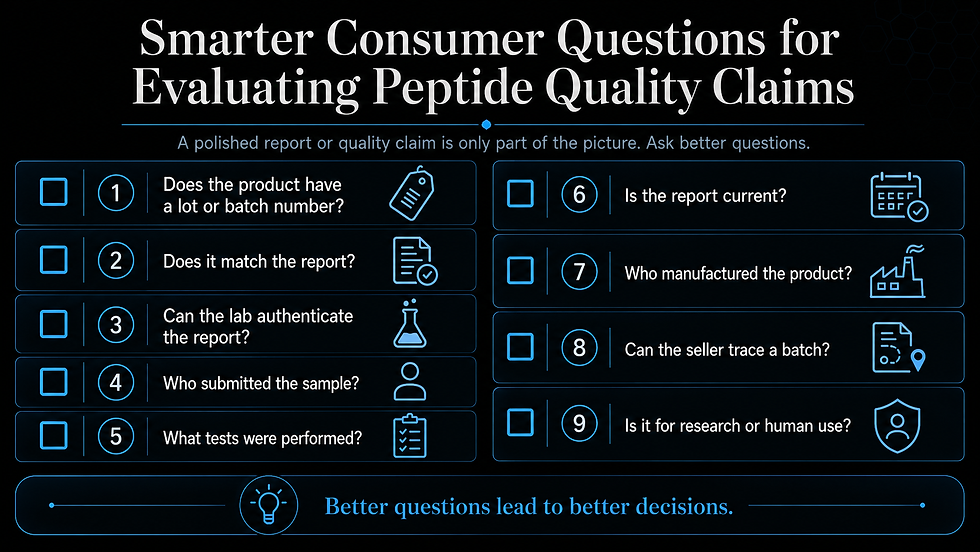
Instead of asking only, “Do you have a COA?” consumers should ask:
Does the physical product carry a lot or batch number?
Does that number match the laboratory report?
Can the laboratory authenticate the report?
Who selected and submitted the sample?
What tests were actually performed?
Does the report apply to the inventory currently being sold?
Who manufactured the product?
Can the seller trace and recall a specific batch?
Is the product intended for research or human use?
If a seller cannot connect the report to the exact product being shipped, the COA offers very little assurance.
The Bottom Line on Peptide COAs
A COA is not worthless. It is simply far less powerful than online marketing suggests.
A legitimate report can provide useful evidence about a tested sample. Its value depends on whether that sample can be traced to a documented production batch and whether the customer’s product carries the same identifying information.
Without that connection, the COA proves that a laboratory tested something.
It does not prove that the customer received it.
“Third-party tested” should be the beginning of the questions, not the end of them. The more reliable markers of quality are identifiable manufacturing, documented batch control, appropriate testing, matching lot numbers, qualified facilities, and a supply chain that remains accountable from production through delivery.
A detached PDF cannot provide that assurance. A functioning quality system can.
Disclaimer
This article is provided for educational and informational purposes only and is not medical advice. Laboratory reports, certificates of analysis, and manufacturing information should not be used as a substitute for evaluation by a licensed healthcare professional. Product quality, individual response, appropriateness, and risk can vary based on the compound, formulation, intended use, manufacturing source, storage, dosing, and the individual.
Consult a qualified licensed healthcare provider before making decisions related to peptides, medications, or other health-related products.
BioBond Labs™ products are intended strictly for research use only and are not for human or veterinary consumption.
References
United States Congress. 21 U.S.C. § 353b: Outsourcing Facilities. Federal Food, Drug, and Cosmetic Act, Section 503B.
United States Congress. 21 U.S.C. § 353a: Pharmacy Compounding. Federal Food, Drug, and Cosmetic Act, Section 503A.
U.S. Food and Drug Administration. Information for Outsourcing Facilities.
U.S. Food and Drug Administration. Compounding and the FDA: Questions and Answers.
U.S. Food and Drug Administration. Guidance for Entities Considering Whether to Register as Outsourcing Facilities Under Section 503B of the Federal Food, Drug, and Cosmetic Act. August 2015.
U.S. Food and Drug Administration. Current Good Manufacturing Practice: Guidance for Human Drug Compounding Outsourcing Facilities Under Section 503B of the FD&C Act. Revised Draft Guidance. January 2021.
Electronic Code of Federal Regulations. Title 21, Part 211: Current Good Manufacturing Practice for Finished Pharmaceuticals.
Electronic Code of Federal Regulations. 21 CFR § 211.160: General Requirements for Laboratory Controls.
Electronic Code of Federal Regulations. 21 CFR § 211.165: Testing and Release for Distribution.
Electronic Code of Federal Regulations. 21 CFR § 211.188: Batch Production and Control Records.
International Council for Harmonisation of Technical Requirements for Pharmaceuticals for Human Use. ICH Q7: Good Manufacturing Practice Guide for Active Pharmaceutical Ingredients. November 2000.
U.S. Food and Drug Administration and International Council for Harmonisation. Q2(R2): Validation of Analytical Procedures. Final Guidance. March 2024.
U.S. Food and Drug Administration. Analytical Procedures and Methods Validation for Drugs and Biologics. Guidance for Industry. July 2015.
U.S. Food and Drug Administration. Process Validation: General Principles and Practices. Guidance for Industry. January 2011.
U.S. Food and Drug Administration. Boothwyn Pharmacy LLC, Warning Letter 710247. June 9, 2025.
Lian Z, Wang N, Tian Y, Huang L. Characterization of Synthetic Peptide Therapeutics Using Liquid Chromatography-Mass Spectrometry: Challenges, Solutions, Pitfalls, and Future Perspectives. Journal of the American Society for Mass Spectrometry. 2021;32(8):1852-1860. doi:10.1021/jasms.0c00479.
Zeng K, Geerlof-Vidavisky I, Gucinski A, Jiang X, Boyne MT II. Liquid Chromatography-High Resolution Mass Spectrometry for Peptide Drug Quality Control. The AAPS Journal. 2015;17(3):643-651. doi:10.1208/s12248-015-9730-z.


Comments