

Everything You Need to Know About GLP-1 Hair Loss Before You Panic!
- biobondlabs
- Feb 2
- 8 min read
Updated: Jun 4

Hair shedding on GLP-1s is one of those things that feels personal and alarming fast. You’re finally making progress, the scale is moving, and then your hairbrush starts looking like a crime scene. People call it “Ozempic hair loss,” “Wegovy hair thinning,” or just “my hair is falling out and I’m freaking out.”
Let’s get grounded.
For most people, what’s happening isn’t permanent hair loss and it usually isn’t the medication “destroying” follicles. It’s your body reacting to rapid change, then cashing that check a few months later.
GLP-1 hair loss is real, but the story people tell about it is usually wrong
Some people do report hair loss during treatment with GLP-1 medications. Regulators and product information documents also list hair loss as an observed adverse event, generally in low single digit percentages, and it shows up more often in people losing larger amounts of weight.
That matters, but it doesn’t automatically mean “the drug causes baldness.”
Most of the time, the pattern people describe looks like temporary shedding, not a permanent follicle problem. That difference is everything.

The most common cause: telogen effluvium, not “drug damage”
The name is annoying. The concept is simple.

Telogen effluvium is a temporary shedding pattern that happens when the body decides it needs to conserve resources. Hair follicles are metabolically expensive. When you’re in a big calorie deficit, losing weight quickly, under-eating protein, or running low on key nutrients, your body quietly shifts more follicles into the resting phase.
Here’s the part that tricks people: the shedding doesn’t start right away. It usually shows up months after the trigger. That delayed timing is classic telogen effluvium.
So someone starts a GLP-1 in January, loses fast through February and March, then hair shedding hits in April or May. The brain says, “It must be the medication.” The biology says, “This is the delayed response to rapid change.”

Weight loss is a known trigger. There’s published literature specifically documenting telogen effluvium associated with weight loss, including the relationship with the rate and magnitude of loss.
Why GLP-1s seem uniquely tied to hair thinning

GLP-1 therapies don’t just help people eat less. They can make “less” become “way less” before the person realizes it. Meals shrink. Protein often drops. Some people are unintentionally running on a diet that would’ve looked like a crash diet in any other decade.
That’s why hair loss gets talked about so much in GLP-1 communities. These medications can create the perfect setup for telogen effluvium: rapid weight loss, lower protein intake, and nutrient gaps, all happening together.
A systematic review and newer analyses have also pointed out that the degree of weight loss appears to track with hair-loss reporting, which supports the “weight loss stress response” explanation more than a direct follicle-toxin theory.
The questions people actually care about.
Is this permanent?
Most of the time, no.
Telogen effluvium doesn’t scar follicles. It doesn’t permanently shut them down. It’s more like the factory paused production because the supply chain got weird. Once the body senses stability again, follicles re-enter growth.
That said, telogen effluvium can uncover an underlying issue you didn’t notice before, like pattern hair loss that was already slowly happening. Shedding can make everything look worse, even if the underlying condition isn’t new. If shedding continues beyond the usual window or you’re seeing obvious patterned thinning, that’s when a clinician evaluation matters.
How long does it last?
Most people experience a surge of shedding that peaks, then gradually settles. The common window you’ll see described clinically is on the order of a few months, with improvement as the trigger resolves and the body stabilizes.
Hair regrowth is slow. Even when follicles restart, it can take months for density to look “normal” again because hair grows like grass, not like a printer.
Will it grow back?
In telogen effluvium, regrowth is the expected outcome once the trigger is addressed. The frustrating part is that regrowth often begins before shedding fully stops, so it can feel like nothing is improving. In reality, the cycle is rebooting.
The myths that keep people stuck
Myth: GLP-1s poison hair follicles
There isn’t strong evidence for that framing. What’s supported far better is a stress-and-weight-loss model, especially given the timing pattern and the relationship to the amount of weight lost.
Myth: If I stop the medication today, the shedding stops tomorrow
Shedding is delayed. By the time you notice it, many follicles already shifted phases weeks earlier. Stopping everything abruptly often doesn’t stop shedding immediately, and it may introduce more stress.
Myth: I just need the right serum
Topicals can be helpful for certain types of hair loss, but telogen effluvium is mostly about what’s happening internally. If the body is still interpreting your current state as resource scarcity, no bottle is going to outvote that signal.
What actually helps, without turning your bathroom into a chemistry lab
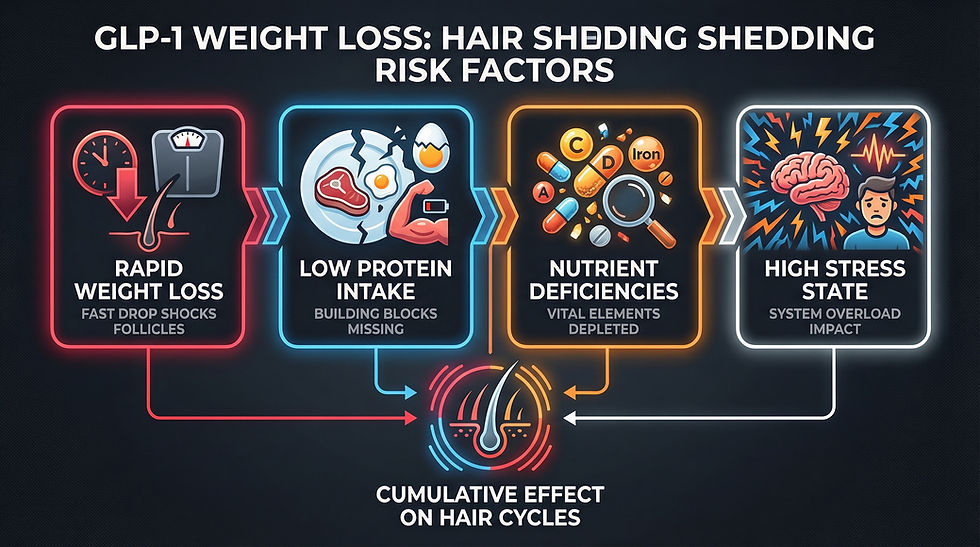
The fix for telogen effluvium is boring, which is why the internet hates it.
Stability helps. Adequate protein helps. Correcting deficiencies helps. Slowing the rate of weight loss can help when it’s extreme. Making intake consistent helps. When those are addressed, the hair cycle usually follows.
This isn’t a place for magic words. It’s basic physiology.
What people are trying: GHK-Cu, AHK-Cu, and other copper peptides
This comes up constantly in hair-loss discussions, so it’s worth addressing directly.
Copper peptides like GHK-Cu have a long history in skin biology and wound-healing research. Laboratory and early clinical work suggests these peptides can influence tissue remodeling and signaling pathways involved in hair follicle activity. That’s why they’re often marketed as regenerative or pro-growth compounds.
Topical copper peptides are biologically plausible, and the research around their mechanisms is interesting. What’s missing is strong human clinical evidence showing they reliably reverse telogen effluvium caused by rapid weight loss. They may support follicle health. That’s different from fixing the underlying trigger.

AHK-Cu has shown activity in laboratory and ex vivo studies, including stimulation of hair follicle elongation and effects on dermal papilla cells. That’s a real signal, but it’s not the same thing as proof that it reverses GLP-1–related shedding in real people.
Subcutaneous copper peptide use gets a lot of attention online. For GLP-1 hair shedding specifically, there’s very little human clinical data supporting injected copper peptides as a solution. Injection also carries real risk when done without medical oversight, regardless of how normalized it looks in forums.
Copper peptides are one of the more scientifically interesting things people are experimenting with and many report anectodtal success with increased growth and thickness in online groups and forums. As of now, at least in clinical studies, they are not a proven fix for GLP-1 hair loss.
What about protein, iron, supplements, and hair loss treatments?
This is where people online start mixing good instincts with bad conclusions.

Does eating more or increasing protein help?
Often, yes. Not because protein “treats” hair loss, but because low protein intake is one of the most common contributors to telogen effluvium during rapid weight loss.
GLP-1 medications can quietly push intake lower than the body tolerates, especially early on. When calories and protein stabilize, the body is more likely to move follicles back into the growth phase. That doesn’t stop shedding immediately, but it supports recovery over time.
Protein doesn’t force regrowth. It removes one of the reasons growth was paused.
Iron and other nutrients
Iron deficiency is a well-established cause of hair shedding, particularly in women. If iron stores are low, correcting that deficiency can help normalize the hair cycle. If levels are normal, adding iron doesn’t accelerate regrowth and can cause problems of its own.
Vitamin D and zinc fall into the same category. Deficiencies matter. Excess rarely helps.
Biotin deserves special mention because it’s so heavily marketed. True biotin deficiency is uncommon, and supplementation hasn’t shown consistent benefit in people with normal levels. High-dose biotin can also interfere with lab testing, which is an underappreciated downside.
The pattern is simple. Supplements help when they correct a deficiency. They don’t override an ongoing stress signal.
What about minoxidil or prescription hair-loss medications like finasteride?
Minoxidil and finasteride come up constantly in GLP-1 hair-loss discussions, but they do very different things.
Minoxidil works by prolonging the growth phase of hair follicles. It’s well studied and commonly used for androgen-related thinning. In the context of telogen effluvium, minoxidil doesn’t correct the underlying trigger, but it may help support regrowth by encouraging follicles to re-enter and stay in the growth phase once shedding begins to slow.
Topical minoxidil is usually considered first because it acts locally. Oral minoxidil is sometimes used off-label, but it has systemic effects and should only be used under medical supervision.
Finasteride works differently. It reduces conversion of testosterone to dihydrotestosterone, which is the hormone that drives androgen-related pattern hair loss. Finasteride does not treat telogen effluvium itself.
This matters because telogen effluvium and pattern hair loss often get mixed together. Rapid shedding can unmask underlying androgen-related thinning that was already present but subtle. In those cases, finasteride may help address the pattern loss component, but it won’t stop stress-related shedding on its own.
Finasteride is a long-term medication with real hormonal effects and potential side effects. It’s not something to start casually or reactively during temporary shedding without proper evaluation.
Used for the right reason, these medications can be helpful. Used for the wrong one, they add complexity without solving the problem.

The part people don’t want to hear
Hair growth returns when the body feels stable. Adequate calories, sufficient protein, and corrected deficiencies create that environment. Treatments and supplements can support the process, but they don’t replace it.
If GLP-1 use has pushed intake too low for too long, no topical or pill can fully outvote that signal.
The simplest explanation is usually the right one
Most GLP-1 hair loss stories follow the same arc.

Appetite drops. Weight comes off quickly. Protein and nutrient intake slip. A few months later, shedding shows up.
That’s telogen effluvium. It’s usually temporary. It’s usually reversible. And it improves as the body stabilizes.
GLP-1 medications didn’t invent this response. They just make weight loss efficient enough that the response becomes visible.
References
Malkud S. Telogen effluvium. Journal of Clinical and Diagnostic Research.
Harrison S, Sinclair R. Telogen effluvium. Clinical and Experimental Dermatology.
Whiting D. Chronic telogen effluvium. Dermatologic Clinics.
Almohanna H et al. The role of vitamins and minerals in hair loss. Dermatology and Therapy.
Rossi A et al. Nutritional factors and hair loss. International Journal of Trichology.
Pickart L. The human tri-peptide GHK and tissue remodeling. Journal of Biomaterials Science.
Hong JW et al. Effects of AHK-Cu on human hair follicle cells. Journal of Dermatological Science.
FDA and EMA safety data for GLP-1 receptor agonists.
For research and educational purposes only. This content is not intended to diagnose, treat, cure, or prevent any disease. Always consult a qualified healthcare professional regarding medical concerns.


Comments