

Help! I Just Started My GLP-1 and It’s Not Working Yet
- biobondlabs
- Feb 9
- 6 min read
Updated: Mar 10

You didn’t start a GLP-1 lightly. You agonized over it. You panicked about side effects. You went down rabbit holes reading about nausea, hair loss, and all the worst-case stories people post online. You talked yourself out of it more than once. But underneath the fear was something heavier. You’ve tried to lose the weight on your own. You’ve done the plans, the discipline, the willpower, the resets. And eventually you had to face a truth that hurt to admit. No matter how badly you wanted it, you couldn’t do this alone. So despite the fear that never fully goes away, you finally took the plunge. And now, after everything it took to get here, you’re staring at the scale, your appetite, your body, and asking one quiet question. Is this actually going to work?
If you’ve only been on a GLP-1 for a few days or even a couple of weeks and it feels like nothing is happening yet, that question is incredibly common. And in most cases, the answer is reassuring.
GLP-1 Not Working Yet? What’s Actually Happening in the First Few Days

In the first few days after starting a GLP-1, there is very little meaningful information to interpret.
These medications are not stimulants. They are not fat burners. They do not shut appetite off overnight. Early doses are intentionally low and often far below what eventually produces strong appetite suppression or consistent weight loss.
At this stage, the medication is still circulating. Receptors involved in appetite regulation are still adapting. Hormonal signaling is still shifting. Feeling normal hunger, eating normal meals, or seeing little change on the scale does not mean the medication is failing. It usually means it is doing exactly what it was designed to do at this point.
Why GLP-1 Medications Are Designed to Start Slow

GLP-1 medications are titrated slowly for a reason.
The starter dose is about tolerance, not results. Side effects such as nausea, vomiting, reflux, and gastrointestinal discomfort become more common as doses increase. Starting low gives your body time to adapt so you can stay on the medication long enough for it to actually help.
This is why increasing the dose early because “nothing is happening yet” is rarely appropriate. The ramp-up phase is not wasted time. It is part of the treatment.
How GLP-1s Actually Cause Weight Loss

GLP-1 medications work by changing behavior signals, not by burning fat directly.
They slow how quickly food leaves your stomach, which increases fullness. They act on areas of the brain that regulate appetite and satiety, reducing food noise and constant cravings. Over time, many people naturally eat less without feeling deprived.
Fat loss happens later. Appetite regulation comes first. Eating patterns shift next. Sustained calorie reduction follows. Only after that does fat loss accumulate in a measurable way.
This is why early scale changes are often modest or nonexistent.
Why the Scale Is a Terrible Judge Early On

In the first few weeks, the scale is often misleading.
Water retention, sodium intake, constipation, and normal day-to-day fluctuations can easily mask fat loss. It is entirely possible to be eating less and still see the same number on the scale for days or weeks.
Early on, the scale reflects hydration and digestion far more than fat loss.
Single, Dual, and Triple Agonists: What Those Terms Actually Mean

These labels get thrown around constantly online, often without explanation.
Single agonists act on one receptor, GLP-1. The most well-known example is semaglutide, sold under brand names like Wegovy and Ozempic. These medications are effective, but intentionally gradual.
Dual agonists act on two receptors, GLP-1 and GIP. Tirzepatide, sold as Zepbound or Mounjaro, falls into this category. In studies, dual agonists produce greater average weight loss than single agonists, but they still follow slow dose escalation schedules.
Triple agonists act on GLP-1, GIP, and glucagon receptors. Retatrutide is the most discussed example and is still investigational. Trial data show substantial weight loss over time, but again, measured over months, not weeks.
More receptors does not mean instant results. It means broader metabolic effects over longer timelines.
Realistic Weight Loss Timelines Based on Studies
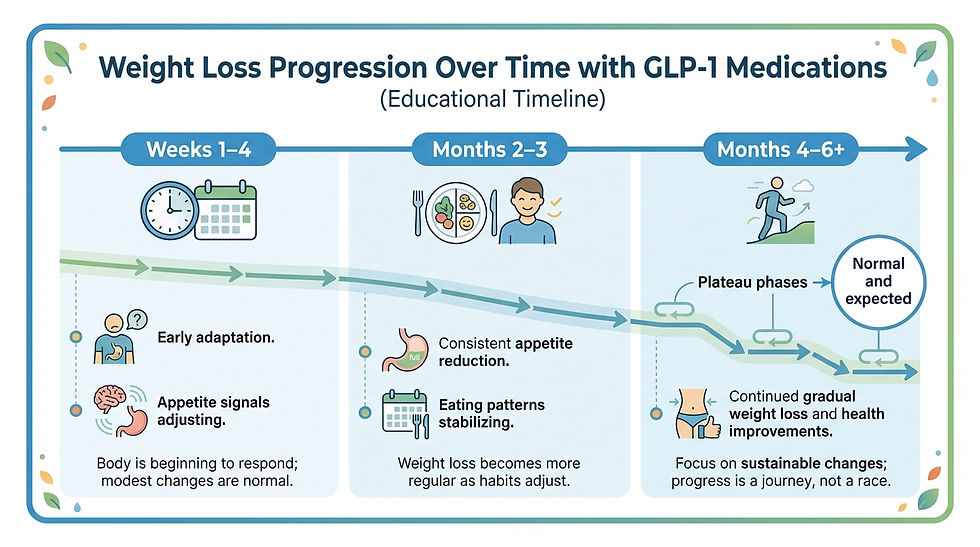
For semaglutide, average weight loss in studies works out to roughly one to two pounds per week once people reach effective doses. That does not mean weight drops immediately. Many people lose little early and more later.
Losing ten pounds in a month on semaglutide is possible for some people, especially early on, but it is not the norm and not something everyone should expect. Slower, steadier loss is far more common.
For tirzepatide, average weight loss is greater over time. Many people lose weight faster than with semaglutide, but again, this occurs over months. Expecting dramatic loss in the first couple of weeks is still unrealistic.
For retatrutide, trial participants lost significant amounts of weight, but those results were measured over 24 to 48 weeks. Even the most powerful agents studied do not produce instant transformations.
Healthy, sustainable weight loss in studies tends to average about 0.5 to 2 pounds per week once treatment is established.
Why People Think Their GLP-1 Isn’t Working When It Is

Several predictable patterns fuel early panic.
People expect appetite suppression to be immediate and total. They eat less often but still choose calorie-dense foods. Constipation hides fat loss on the scale. Stress and poor sleep increase hunger signals. Social media exaggerates extreme outcomes and makes normal progress look like failure.
None of this means the medication is ineffective. It means expectations were shaped by anecdotes instead of evidence.
When “Not Working Yet” Might Actually Matter

True non-responders exist, but they are not identified early.
A non-responder is typically someone who has spent adequate time at a therapeutic dose and has not achieved meaningful weight loss or appetite changes. Clinicians often look for benchmarks such as failing to lose around five percent of body weight after several months at an effective dose.
If someone reaches a stable, higher dose, adheres consistently, and still sees little change after three to six months, that is when reassessment makes sense.
That is also when it is appropriate to talk to a doctor about dose adjustments, alternative medications, or other contributing factors.
Feeling nothing after a few days or weeks does not meet that definition.
The Bottom Line
If you just started a GLP-1 and it is not working yet, that is almost always a timing issue, not a failure.
These medications were designed to work gradually, safely, and sustainably. Early fear does not mean you made the wrong choice. It usually means you care deeply and want this to work. Give the biology time to catch up to the hope that brought you here.
References
Wilding JPH et al. Once-Weekly Semaglutide in Adults with Overweight or Obesity. New England Journal of Medicine.
Jastreboff AM et al. Tirzepatide Once Weekly for the Treatment of Obesity. New England Journal of Medicine.
Rubino DM et al. Effect of Continued Weekly Subcutaneous Semaglutide vs Placebo on Weight Loss Maintenance. JAMA.
FDA Prescribing Information. Wegovy (semaglutide).
FDA Prescribing Information. Zepbound (tirzepatide).
EMA European Public Assessment Report. Semaglutide for obesity.
Nauck MA et al. GLP-1 receptor agonists and appetite regulation. Diabetes Care.
Mayo Clinic. How fast does semaglutide work.
Cleveland Clinic. GLP-1 medications and weight loss expectations.
Jastreboff AM et al. Triple-hormone receptor agonist retatrutide in adults with obesity. New England Journal of Medicine.
Astrup A et al. Safety and tolerability considerations of GLP-1 receptor agonists. The Lancet.
American Diabetes Association. Standards of Medical Care in Diabetes. Pharmacologic approaches to weight management.
Disclaimer
This content is provided for general educational and informational purposes only. It is not intended to provide medical advice, diagnosis, or treatment, and should not be relied upon as a substitute for professional medical guidance. GLP-1 medications and related therapies should only be used under the supervision of a licensed healthcare provider. Individual responses, timelines, and outcomes can vary. Always consult your physician or qualified healthcare professional before starting, stopping, or changing any medication or treatment plan.


Comments