

More Receptors, More Weight Loss? The GLP-1 Switching Debate
- biobondlabs
- Aug 6
- 10 min read

More Receptors, More Weight Loss? The GLP-1 Switching Debate
One receptor became two, two became three, and a simple narrative took hold: every additional receptor target must produce more weight loss.
That assumption helps explain the growing interest in switching from semaglutide to tirzepatide and, more recently, from tirzepatide to retatrutide. If semaglutide activates GLP-1, tirzepatide adds GIP, and retatrutide adds glucagon, moving to the next compound can appear to be an obvious upgrade.
Clinical trials do show progressively greater average weight loss across these compounds. What they don’t establish is that switching automatically restarts weight loss, that every added receptor guarantees a benefit, or that results from separate trials can be compared as though they came from one controlled experiment.
The GLP-1 switching debate is ultimately about how much the existing research can actually predict.
From One Receptor to Three
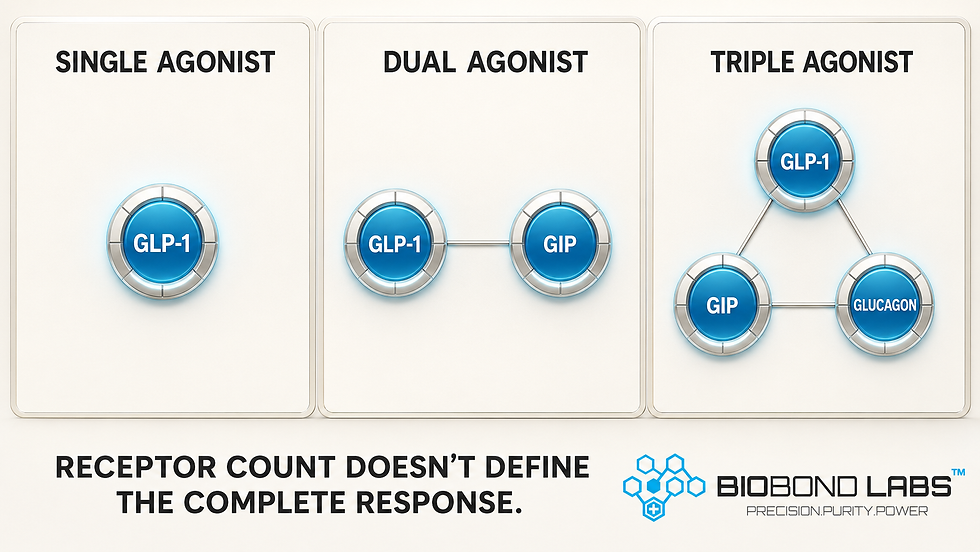
Semaglutide, tirzepatide, and retatrutide represent three stages in the development of incretin-based metabolic compounds.
Semaglutide activates the glucagon-like peptide-1 receptor. GLP-1 receptor activity influences insulin secretion, glucagon regulation, gastric emptying, satiety, appetite, and food intake.
Tirzepatide activates both GLP-1 and glucose-dependent insulinotropic polypeptide receptors. Its combined GIP and GLP-1 activity supports glucose regulation while influencing appetite, energy intake, and adipose-tissue biology.
Retatrutide activates GLP-1, GIP, and glucagon receptors. Its glucagon activity may contribute to energy expenditure, lipid metabolism, and fat oxidation, while its GLP-1 and GIP activity helps regulate food intake and glucose.
Adding a receptor doesn’t simply add a fixed amount of weight loss. Each compound has its own receptor potency, signaling behavior, exposure profile, tissue distribution, and balance among its targets. The result depends on how those signals interact, not merely how many receptors are involved.
Why Receptor Count Isn’t a Measure of Potency
Two compounds can activate the same receptor while producing different downstream effects. One may activate a receptor more strongly, remain in circulation longer, reach different tissues, or favor particular signaling pathways after binding.
This is sometimes described as biased agonism. Receptor activation isn’t always a simple on-or-off event. The pattern of signaling can matter as much as the target itself.
The glucagon component of retatrutide illustrates the complexity. Glucagon receptor activation may increase energy expenditure and promote fat oxidation. It can also increase hepatic glucose production. Retatrutide trials have reported increases in heart rate as well, although the contribution of each receptor to that effect hasn’t been isolated.
The value of triple agonism depends on whether the compound’s complete signaling profile balances those effects effectively.
Retatrutide is therefore not simply tirzepatide with an extra metabolism switch. It is a different compound with a different pharmacologic balance.
A Plateau Doesn’t Necessarily Mean Receptor Failure

Many switching discussions begin with the assumption that the original compound has stopped working.
Research on weight-loss plateaus suggests a different explanation.
As body weight decreases, less energy is required to maintain it. Appetite feedback strengthens, spontaneous activity may decline, and the energy deficit responsible for the initial loss narrows.
Eventually, energy intake and expenditure approach a new equilibrium.
GLP-1-based compounds can delay that equilibrium by reducing appetite and energy intake. They don’t eliminate the body’s compensatory response indefinitely.
A plateau can therefore occur while receptor activity continues.
The compound may still be reducing appetite, supporting metabolic control, and preventing regain. Its visible effect has shifted from active weight reduction to maintenance.
A stable weight trajectory doesn’t prove that GLP-1 receptors have become resistant or that another receptor target will restart the original rate of loss.
What GLP-1 Switching Research Actually Shows

Direct switching research remains limited, particularly for obesity treatment.
Prospective and observational studies have examined people with type 2 diabetes who changed from a GLP-1 receptor agonist to tirzepatide. These studies generally report additional reductions in body weight and A1C.
In one prospective study, participants were followed for 12 weeks after changing directly from a stable GLP-1 receptor agonist regimen to tirzepatide. Average body weight decreased by approximately 2.15 kilograms, while A1C declined by approximately 0.43 percentage points.
That supports the possibility of additional benefit after switching, but the study had important limitations.
The participants had type 2 diabetes, follow-up was short, and the trial wasn’t designed specifically around people who had plateaued on obesity-dose semaglutide.
Smaller retrospective reports have produced similar findings, but varying previous treatments, small study populations, and clinical-practice data make the results difficult to generalize.
The research indicates that additional progress is possible. It doesn’t provide reliable probabilities for renewed loss, continued maintenance, temporary regain, poor tolerability, or discontinuation after a switch.
Head-to-Head Results Answer a Different Question
The strongest comparison between semaglutide and tirzepatide comes from SURMOUNT-5.
At 72 weeks, participants assigned to tirzepatide lost an average of 20.2% of their starting weight. Those assigned to semaglutide lost an average of 13.7%. Tirzepatide also produced greater reductions in waist circumference and a higher likelihood of reaching major weight-loss thresholds.
This establishes greater average efficacy for tirzepatide in the population studied. It doesn’t mean someone who already lost 15% with semaglutide will lose another 20.2% after changing compounds.
SURMOUNT-5 followed participants assigned to one treatment or the other from the beginning. It didn’t enroll people who had plateaued on semaglutide and randomize them either to remain on semaglutide or transition to tirzepatide.
A head-to-head trial can determine which treatment performs better on average under controlled conditions. A switching trial asks how prior exposure affects the response to the next compound.
Those questions require different study designs.
Where Retatrutide Changes the Discussion

Retatrutide has produced some of the largest average weight reductions reported for an incretin-based compound.
In its Phase 2 obesity trial, the highest studied group experienced an average weight reduction of 24.2% at 48 weeks, with weight loss still continuing at the end of the trial.
Lilly later reported Phase 3 TRIUMPH-1 results showing average weight loss of up to 28.3% at 80 weeks. A substantial percentage of participants lost at least 30% of their starting weight.
Those findings strengthen the evidence that retatrutide has considerable metabolic activity. However, retatrutide remains investigational and isn’t FDA-approved as of August 2026.
Some recently announced Phase 3 findings are still sponsor-reported results rather than complete peer-reviewed publications. Long-term cardiovascular outcomes and extended safety data are also developing.
Most importantly, no completed trial has established what happens when people who have plateaued on tirzepatide transition to retatrutide.
Retatrutide Versus Tirzepatide
Cross-trial results make retatrutide appear to produce greater average weight loss than tirzepatide. Retatrutide reached 24.2% in Phase 2 and up to 28.3% in recently disclosed Phase 3 research. Tirzepatide produced up to 22.5% in SURMOUNT-1 and 20.2% in the active-comparator SURMOUNT-5 trial.
Those percentages weren’t generated under identical conditions.
The trials differed in participant characteristics, duration, escalation schedules, adherence, statistical estimands, dropout handling, and comparator groups. Comparing the largest percentage from one trial with the largest percentage from another can generate a hypothesis. It can’t prove superiority.
TRIUMPH-5 is designed to provide the direct comparison currently missing. The Phase 3 trial is comparing retatrutide with tirzepatide in approximately 800 adults with obesity and is expected to conclude in late 2026.
Even that trial won’t fully answer the switching question unless participants with prior tirzepatide exposure are examined separately. A direct comparison can establish relative average efficacy. It may not predict what happens after a tirzepatide plateau.
Does Retatrutide Suppress Appetite Less?

Some anecdotal reports claim that retatrutide produces less noticeable appetite suppression than tirzepatide.
The theory is that retatrutide’s glucagon activity may contribute more strongly to energy expenditure, allowing substantial weight loss without the same perceived reduction in hunger.
Current human evidence doesn’t establish that conclusion.
Tirzepatide has direct experimental evidence showing reduced food intake. In a controlled six-week study, participants receiving tirzepatide consumed approximately 525 fewer calories during an unrestricted test meal than those receiving placebo. They also reported less hunger, fewer food cravings, less overeating, and lower responsiveness to food cues.
Retatrutide hasn’t been directly compared with tirzepatide in a completed human study specifically measuring appetite, food cravings, or energy intake.
Someone may genuinely experience more hunger on one compound than another. That individual observation doesn’t establish a population-level difference.
Perceived appetite and total weight change also aren’t equivalent measures. Weight can be influenced by energy intake, energy expenditure, fat oxidation, glucose regulation, gastrointestinal tolerability, adherence, and body composition. Greater weight loss doesn’t necessarily require the strongest conscious sensation of appetite suppression.
For now, the claim remains plausible as an individual experience but unproven as a general pharmacologic difference.
Can Incretin-Based Compounds Be Combined?

Combining compounds may sound like a way to assemble a preferred receptor profile. One compound could theoretically provide stronger appetite effects while another adds glucagon activity.
No robust clinical evidence supports combining semaglutide, tirzepatide, or retatrutide with one another for greater weight loss.
The receptor activity already overlaps.
Semaglutide and tirzepatide both activate GLP-1 receptors. Tirzepatide and retatrutide both activate GLP-1 and GIP receptors. Combining them wouldn’t create a clean division of functions. It would create overlapping exposure with uncertain pharmacodynamics.
Wegovy and Zepbound prescribing information states that concurrent use with another GLP-1 receptor agonist isn’t recommended. Retatrutide has no approved prescribing information because it remains investigational.
An engineered multi-receptor molecule has a deliberately designed balance among its targets. Separately combining molecules doesn’t reproduce that balance, and no controlled evidence establishes that it improves results.
Why Switching Responses Vary
Clinical-trial averages contain substantial individual variation. Participants include rapid responders, gradual responders, modest responders, and people who experience little meaningful change.
Responses may differ because of receptor biology, insulin resistance, diabetes status, previous treatment exposure, gastrointestinal tolerability, concurrent medications, treatment adherence, energy intake, sleep, and other health conditions.
Switching may introduce a more effective receptor profile for one person. For another, it may improve tolerability or adherence. Some may maintain their previous loss without significant additional change, while others may struggle to tolerate the new compound.
This variation is why average trial rankings can’t be converted into individual guarantees.
What Can Be Concluded Today
Research supports greater average weight loss with tirzepatide than semaglutide in a direct obesity trial. Limited switching studies also suggest that some people previously treated with a GLP-1 receptor agonist experience additional weight and glycemic improvement after changing to tirzepatide.
Retatrutide has demonstrated substantial activity in Phase 2 and recently disclosed Phase 3 research. Its glucagon component provides a scientifically plausible pathway for metabolic effects beyond GLP-1 and GIP receptor activation alone.
What remains unknown is just as important. Current evidence can’t reliably predict who will resume losing after a switch, establish that every plateau reflects receptor tolerance, confirm that retatrutide is superior to tirzepatide, or support combining overlapping incretin-based compounds.
The development of semaglutide, tirzepatide, and retatrutide represents a genuine advance in metabolic pharmacology. But receptor count is only one part of the story. The more important questions concern signaling balance, comparative evidence, individual variability, and whether the next study actually measures the outcome people want to understand.
Disclaimer
This article is provided for educational and informational purposes only. It summarizes published and emerging research and isn’t medical advice, a treatment recommendation, or a substitute for consultation with a licensed healthcare provider. It doesn’t recommend starting, stopping, switching, combining, or otherwise using any medication or research compound. Individual responses observed in clinical research vary, and study results shouldn’t be interpreted as guarantees of safety or effectiveness.
Retatrutide remains investigational and isn’t FDA-approved as of August 2026. References to FDA-approved semaglutide or tirzepatide apply only to specific authorized prescription drug products and don’t apply to BioBond Labs™ materials. All BioBond Labs™ products are intended strictly for laboratory research use only and aren’t for human or veterinary consumption. Readers interested in telehealth options and products intended for human use can visit Reclaim Medical.
References
Hall KD. Physiology of the weight-loss plateau in response to diet restriction, GLP-1 receptor agonism, and bariatric surgery. Obesity. 2024;32(6):1163-1168. PubMed
Willard FS, Douros JD, Gabe MBN, et al. Tirzepatide is an imbalanced and biased dual GIP and GLP-1 receptor agonist. JCI Insight. 2020;5(17):e140532. PubMed
Coskun T, Urva S, Roell WC, et al. LY3437943, a novel triple glucagon, GIP, and GLP-1 receptor agonist for glycemic control and weight loss: From discovery to clinical proof of concept. Cell Metabolism. 2022;34(9):1234-1247.e9. PubMed
Wilding JPH, Batterham RL, Calanna S, et al. Once-weekly semaglutide in adults with overweight or obesity. New England Journal of Medicine. 2021;384:989-1002. PubMed
Jastreboff AM, Aronne LJ, Ahmad NN, et al. Tirzepatide once weekly for the treatment of obesity. New England Journal of Medicine. 2022;387:205-216. PubMed
Aronne LJ, Horn DB, le Roux CW, et al. Tirzepatide as compared with semaglutide for the treatment of obesity. New England Journal of Medicine. 2025;393(1):26-36. PubMed
Frías JP, Davies MJ, Rosenstock J, et al. Tirzepatide versus semaglutide once weekly in patients with type 2 diabetes. New England Journal of Medicine. 2021;385:503-515. PubMed
Jabbour S, et al. Switching to tirzepatide 5 mg from glucagon-like peptide-1 receptor agonists: Clinical expectations in the first 12 weeks of treatment. Endocrine Practice. 2024;30(8):701-709. PubMed
Barakat S, Ramdeen SC, Khaimova R. Safety and efficacy of switching patients with type 2 diabetes mellitus from GLP-1 receptor agonists to tirzepatide. Hospital Pharmacy. 2024. PubMed
Jain AB, Ali A, Gorgojo Martínez JJ, et al. Switching between GLP-1 receptor agonists in clinical practice: Expert consensus and practical guidance. International Journal of Clinical Practice. 2021;75:e13731. PubMed
Jastreboff AM, Kaplan LM, Frías JP, et al. Triple-hormone-receptor agonist retatrutide for obesity: A Phase 2 trial. New England Journal of Medicine. 2023;389:514-526. PubMed
Rosenstock J, Frias J, Jastreboff AM, et al. Retatrutide, a GIP, GLP-1, and glucagon receptor agonist, for people with type 2 diabetes: A randomized, double-blind, placebo and active-controlled, parallel-group Phase 2 trial. The Lancet. 2023;402:529-544. PubMed
Martin CK, Carmichael OT, Carnell S, et al. Tirzepatide on ingestive behavior in adults with overweight or obesity: A randomized 6-week Phase 1 trial. Nature Medicine. 2025;31:3141-3150. PubMed
Eli Lilly and Company. Lilly’s triple agonist, retatrutide, delivered powerful weight loss in pivotal Phase 3 obesity trial. May 21, 2026. TRIUMPH-1 Results
National Library of Medicine. A study of retatrutide compared with tirzepatide in adults who have obesity. TRIUMPH-5, ClinicalTrials.gov identifier NCT06662383. ClinicalTrials.gov
Eli Lilly and Company. What to know about retatrutide. Updated 2026. Lilly Retatrutide Research and Regulatory Status
Novo Nordisk. Wegovy prescribing information. Revised June 2026. Official Prescribing Information
Eli Lilly and Company. Zepbound prescribing information. Official Prescribing Information


Comments